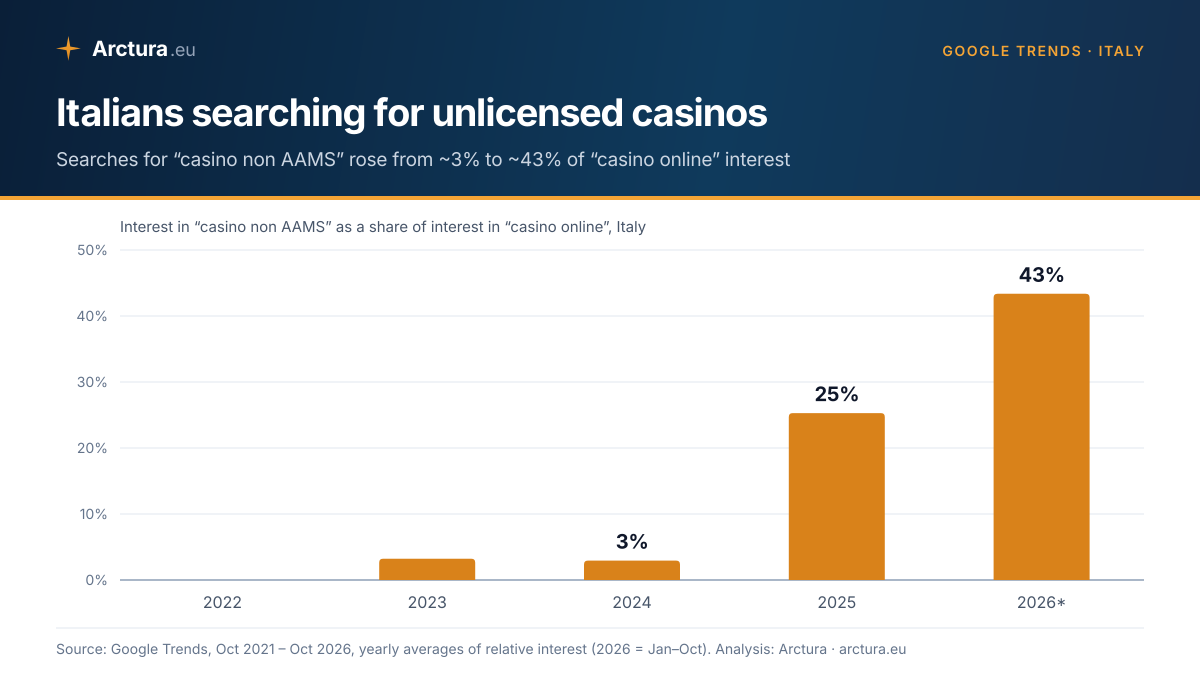
- In Google Trends, searches like 'casino ohne LUGAS' (Germany) and 'casino non AAMS' (Italy) were near zero until 2024 and rose sharply in 2025 and 2026; in Italy, interest in 'casino non AAMS' reached roughly 43% of the interest in 'casino online' in 2026, against about 3% in 2024.
- Trends shows relative interest, not market size, and affiliate spam inflates these terms; the direction is still clear, and unlicensed sites now advertise 'no KYC' and 'instant withdrawal' as selling points.
- Three groups sit behind these searches: players annoyed by friction, players avoiding regulatory limits, and self-excluded or at-risk players. Support can only win back the first group, and must never compete for the third.
- Most avoidable friction is communication: verification requested at the first withdrawal without warning, vague document rejections, and 'where is my money?' answered with a generic processing-time paragraph.
- The fix is not fewer checks. It is telling players earlier, exactly and at any hour what is needed, why, and what happens next, and measuring repeat KYC contacts and time to a specific withdrawal answer.
Unlicensed casinos have found a new headline. Not bigger bonuses, but the absence of the things licensed operators are required to do: "no KYC", "no verification", "instant withdrawal", "not on GamStop", "ohne LUGAS". Search data suggests players are responding. In several European markets, searches for casinos without verification and for sites outside the national licensing system were close to zero until 2024 and have climbed sharply since.
Some of the reasons are regulatory, and no support desk can change them. Some are friction — verification that arrives as a surprise, rejections nobody explains, withdrawals nobody can give a date for — and that is a service problem licensed operators can fix without loosening a single check. This article looks at the data, what it does and does not prove, and what to change in KYC and withdrawal support.
What the search data shows
We looked at Google Trends for October 2021 to October 2026, comparing each market's black-market search term with its ordinary term for online casinos. Values are yearly averages of Google's relative interest index within each market (2026 runs to October); they are comparable within a row, not between countries.
| Market | Search term | 2022 | 2023 | 2024 | 2025 | 2026 |
|---|---|---|---|---|---|---|
| Italy | casino non AAMS | 0.0 | 0.1 | 0.1 | 2.2 | 12.1 |
| casino online | 2.4 | 3.1 | 3.4 | 8.7 | 27.9 | |
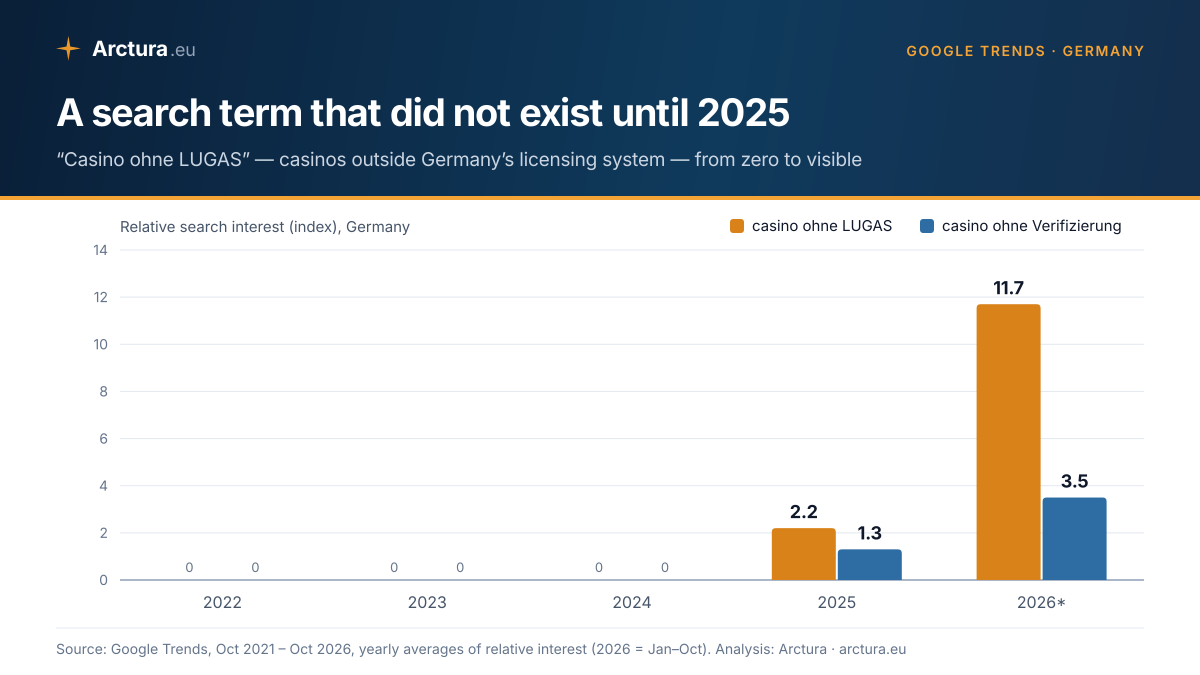
| Germany | casino ohne LUGAS | 0.0 | 0.0 | 0.0 | 2.2 | 11.7 |
| casino ohne Verifizierung | 0.0 | 0.0 | 0.0 | 1.3 | 3.5 | |
| United Kingdom | not on GamStop | 0.9 | 0.4 | 0.3 | 1.4 | 1.8 |
| online casino | 7.1 | 6.5 | 6.5 | 19.0 | 19.0 | |
| France | casino sans vérification | 0.0 | 0.0 | 0.0 | 0.5 | 0.8 |
| casino en ligne | 4.3 | 4.8 | 5.9 | 16.6 | 26.5 |
Three things stand out:
- Italy shows the strongest shift. Interest in "casino non AAMS" — sites without an Italian licence — was about 3% of the interest in "casino online" in 2024. In 2026 it is about 43%.
- Germany's new term did not exist three years ago. "Casino ohne LUGAS" — casinos outside the system that enforces the cross-operator deposit limit — went from nothing to a clearly visible term in two years. "Ohne Verifizierung" follows the same curve at a lower level.
- The UK and France move less. "Not on GamStop" roughly doubled as a share of "online casino" interest, from about 5% to about 9%. In France, "sans vérification" is still small.
Overall interest in online casinos also grew in every market we checked, while a control term (pizza, in Germany) stayed flat. The black-market terms grew faster.
What the data does not prove
Google Trends is a useful compass and a poor scale. Read it with three limits in mind:
- It is relative, not absolute. It shows how interest changes over time within a market, not how many players there are or how large the black market is. Channelisation estimates from regulators and industry bodies are the right source for size.
- Affiliate spam inflates these terms. Many "rising" related queries are the domain names of affiliate sites targeting exactly these phrases. That is itself a signal — someone finds it worth paying for — but it means the curves overstate pure player demand.
- A search is not a switch. Someone searching "casino ohne LUGAS" may be curious, comparing, or already gone. The data shows intent rising, not players lost.
What the data does show reliably is direction and vocabulary: players increasingly describe what they want in terms of what licensed operators require.
Three kinds of players behind these searches
Treating everyone who types these words as one audience leads to the wrong response. There are at least three groups, and they need opposite answers:
| Group | What they are reacting to | Can support win them back? |
|---|---|---|
| Friction-averse players | Verification as a surprise at the first withdrawal, vague rejections, slow or silent payment answers | Yes — this is mostly a communication problem |
| Limit-avoiding players | Regulatory deposit limits, stake limits, cross-operator rules | Rarely — the rule is set by the regulator, not the operator. Support can explain it respectfully |
| Self-excluded or at-risk players | Being blocked by a self-exclusion scheme or by their own limits | No, and it must not try — this is a responsible-gambling situation |
The third group deserves a clear line. A player searching for sites "not on GamStop" may be a self-excluded player trying to get around their own exclusion. A licensed operator's job here is the opposite of competing: recognise the signal if it appears in a conversation and follow the responsible-gambling process. How to detect those signals in chats is covered in responsible gambling signals in support chats.
The friction licensed operators can fix
Black-market sites advertise against specific moments of licensed play. Most of those moments are support moments:
| The moment | What the unlicensed ad promises | What a licensed operator can fix |
|---|---|---|
| First withdrawal triggers verification | "No KYC" | Tell players before they deposit when and why documents will be needed; send the request early, not at cash-out |
| Document rejected | "No documents" | Say exactly what was wrong and what a valid document looks like, in the player's language; one specific instruction instead of a generic rejection |
| Waiting for verification | "Instant account" | Answer status questions from the account: received, in review, expected time, next step |
| Withdrawal pending | "Instant withdrawal" | Diagnose the actual state — processing window, wagering, missing document, method mismatch — and give a date, not a paragraph |
| Question at 2 a.m. | "24/7 live chat" | Account-aware answers around the clock, with money decisions still queued for people |
| "Why do you need this?" | "We don't ask" | Explain plainly that verification protects the player's money and identity and is required by the licence |
None of these steps removes a check. They change when the player learns about it, how precisely it is explained, and how fast a question about it is answered. The account states behind "where is my withdrawal?" and how to break the KYC rejection loop are set out in how to automate withdrawal and KYC questions.
The answer to "no KYC" marketing is not lighter verification. It is verification that never comes as a surprise, never gets rejected without a reason, and never leaves a player asking about their money without a specific answer — including at night.
Why nights matter more than they look
Payment anxiety does not keep office hours. A player who requests a withdrawal in the evening and meets a verification request will often ask about it within the hour. If the answer is a closed chat, an automated "we'll reply within 24 hours" or a generic help-centre article, the next search they make may be one of the terms in the table above. A specific answer — "your proof of address was received at 21:40 and is in the review queue; reviews usually finish by tomorrow afternoon; you'll get an email" — costs little and removes the reason to look elsewhere.
This is where AI support connected to the player account earns its place: reading verification and withdrawal state at any hour and answering from it, while payouts, document decisions and anything sensitive stay with people. That is what PlayerDesk does, and the broader practices are in iGaming customer support best practices.
See how much of your queue is players asking about verification and their money.
Send an anonymised 30-day chat export; get topics, hours and languages, including the share of KYC and withdrawal contacts and when they arrive.
What not to do
- Don't loosen checks to compete. Verification is a licence and anti-money-laundering requirement, and it protects players from fraud and account takeover.
- Don't market against your own regulator. Explaining a deposit limit respectfully is good service; implying it is the regulator's fault and you would prefer to ignore it is not.
- Don't try to win back self-excluded players. If a conversation suggests someone is trying to get around their own exclusion or limits, it goes to the responsible-gambling process, not to retention.
- Don't promise speed you can't deliver. "Instant" in a licensed context is a liability. A truthful expected time beats an optimistic one that produces a second contact and a complaint.
How to measure it
If friction is pushing players away, it shows up in your own data long before it shows up in Google Trends:
- Repeat contacts within 24 hours on verification and withdrawal topics.
- Time to a specific answer on withdrawal questions, split by hour of day — overnight is usually the worst.
- Drop-off at the verification step: players who receive a document request and never complete it.
- Rejection-to-resubmission rate: how often a rejected document is followed by a correct one, a second wrong one, or nothing.
- Activity after a verification contact: whether players who contacted support about KYC keep depositing over the following weeks.
Unlicensed sites sell the absence of friction. Licensed operators can't remove the checks, but they can remove the surprise.
The short version
Search interest in casinos "without verification", "ohne LUGAS" and "non AAMS" has risen sharply since 2025, most strongly in Italy and Germany. The data is relative and inflated by affiliate spam, but the direction is clear, and black-market sites now sell the absence of KYC and the promise of instant withdrawals. Some players behind those searches are reacting to rules no operator can change, and some are at-risk players who must not be competed for. The rest are reacting to friction — surprise verification, vague rejections and unanswered questions about their money — and that is fixable in support, around the clock, without weakening a single check.
Frequently asked questions
Why are players searching for casinos without verification?
For three different reasons: some are frustrated by verification friction, such as documents requested only at the first withdrawal or repeated rejections; some want to avoid regulatory limits such as Germany's cross-operator deposit limit; and some are self-excluded or at-risk players looking for sites outside national protection schemes. Only the first group is a service problem a licensed operator can fix.
What does 'ohne LUGAS' mean?
LUGAS is Germany's cross-operator system for licensed online gambling, used to enforce the monthly deposit limit across operators and to prevent playing at several licensed sites at the same time. Searches for casinos 'ohne LUGAS' are searches for sites outside the German licensing system.
What does 'casino non AAMS' mean?
AAMS is the former name of the Italian gambling regulator, now ADM. A 'non AAMS' casino is a site without an Italian licence. Rising searches for the term indicate growing interest in unlicensed offers among Italian players.
Should licensed casinos make verification easier to compete with the black market?
They should make it clearer, not weaker. Checks required by licence and anti-money-laundering rules stay. What can change is when players are told, how precisely missing documents are explained, how fast status questions are answered, and whether answers are available at night.
How reliable is Google Trends data on black-market gambling searches?
It shows relative interest over time within a market, not the number of players or the size of the black market, and affiliate sites targeting these terms can inflate it. It is useful for direction and timing, and best read alongside regulator and industry estimates of channelisation.
Last reviewed 28 October 2026. Figures marked as industry ranges are ranges, not Arctura claims; operator-specific numbers are only quoted after validation on the operator's own baseline.